Understanding a difficult subject can feel overwhelming when your notes are filled with long paragraphs, complicated definitions, and ideas that seem unrelated. Whether you are studying biology, mathematics, history, economics, or another challenging subject, it can be difficult to see how individual concepts fit together.
One practical way to organize information is to use mind maps. A mind map turns a central topic into a visual structure of connected ideas, helping you break complex material into smaller, more manageable sections.
Learning how to use mind maps for studying can help you organize your notes, identify relationships between concepts, review important information, and prepare for exams more effectively. Instead of simply rereading pages of notes, you can create a visual overview of what you are learning and use it to test your understanding.
In this guide, you will learn what mind maps are, how to create them step by step, which subjects benefit from them, and how to use them as part of a productive study routine.
What Is a Mind Map?
A mind map is a visual learning tool that organizes information around a central topic. Related ideas branch out from the main topic, and smaller branches provide supporting details, examples, definitions, or explanations.
For example, if you are studying the human digestive system, you could write Human Digestive System in the center of a page. Your main branches might include the mouth, esophagus, stomach, small intestine, large intestine, and digestive enzymes. Smaller branches could explain each organ’s function and its role in digestion.
This structure makes it easier to see how different parts of a topic relate to one another.
Mind maps usually include:
- A central topic: The main subject you want to understand.
- Main branches: The major categories or concepts.
- Sub-branches: Supporting facts, explanations, examples, and definitions.
- Keywords: Short phrases that represent important information.
- Visual cues: Colors, symbols, arrows, or simple drawings that help distinguish ideas.
Unlike traditional notes, which are often written in a linear format, mind maps show information in a connected visual arrangement.
Why Are Mind Maps Useful for Difficult Subjects?
Difficult subjects often contain many related concepts that must be understood together. A mind map helps organize these concepts so you can focus on both individual details and the bigger picture.
1. They Break Complex Topics Into Smaller Parts
A large chapter can seem difficult because it contains too much information to process at once. A mind map divides the chapter into smaller categories, allowing you to concentrate on one section at a time.
For instance, a chapter about climate change might be divided into causes, environmental effects, economic consequences, and possible solutions. Each branch can then be developed separately.
This approach makes the material feel more manageable and gives you a clear starting point.
2. They Help You Identify Connections
Understanding a subject involves more than memorizing definitions. You also need to understand how ideas influence, support, or differ from one another.
A mind map can reveal these relationships. In economics, for example, you could connect inflation with purchasing power, production costs, interest rates, and consumer demand.
Seeing these relationships together may help you develop a deeper understanding of the topic rather than treating each concept as an isolated fact.
3. They Make Revision More Organized
When exam preparation begins, students often need to review several chapters in a limited amount of time. A well-organized mind map provides a compact overview of the most important concepts.
You can use it to identify key definitions, major processes, supporting examples, and areas that require additional revision.
However, a mind map should complement detailed notes and practice questions rather than replace every other study method.
4. They Encourage Active Learning
Creating a mind map requires you to decide which ideas are important and how they relate to the main topic. This process can encourage you to organize information in your own words.
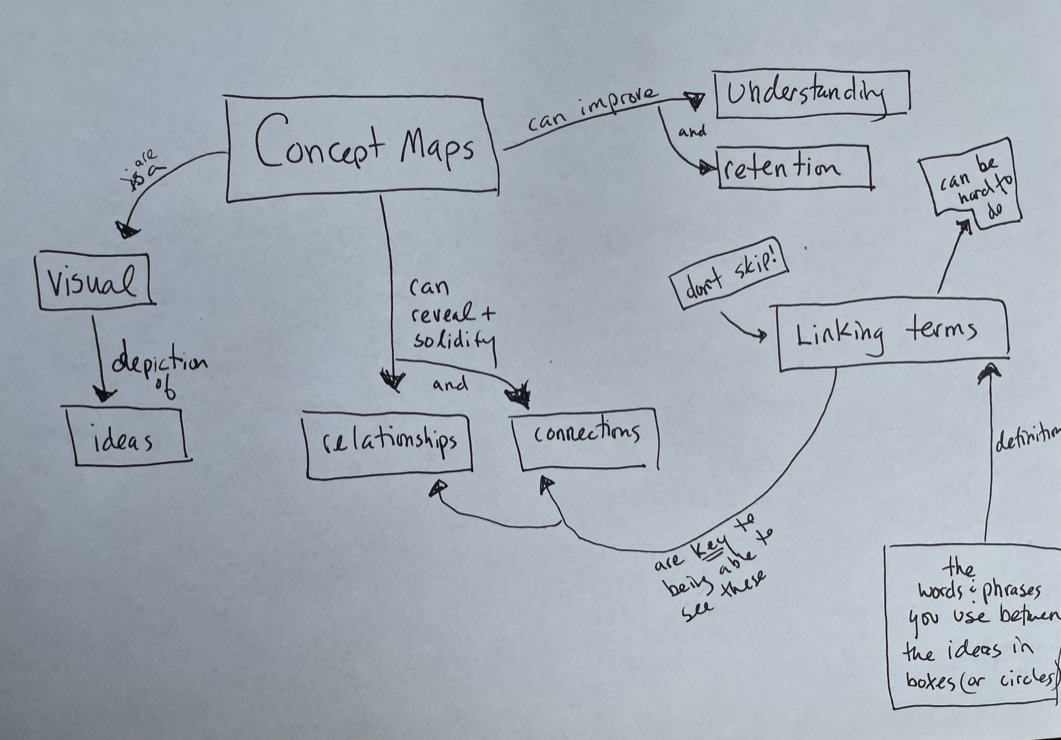
Research on concept mapping has found positive learning benefits across several educational settings, although results depend on how the maps are created and used. For stronger revision, try drawing your map from memory instead of copying information directly from a textbook.
How to Use Mind Maps for Studying: A Step-by-Step Guide
You do not need advanced drawing skills or expensive software to create an effective mind map. A sheet of paper and a pen are enough to get started.
Step 1: Choose One Specific Topic
Begin with a topic that is narrow enough to organize clearly.
Instead of creating a map for an entire subject such as biology, choose a specific chapter or concept, such as photosynthesis, cell division, or the nervous system.
A focused topic makes it easier to identify the most important information without overcrowding the page.
Before you begin, ask yourself what you want to understand by the end of the study session.
Step 2: Write the Main Idea in the Center
Place the topic in the center of your page and draw a circle or shape around it.
For example, if you are studying photosynthesis, write Photosynthesis in the center. You can add a small drawing of a leaf if it helps you remember the topic.
Keep the central idea short and easy to recognize. The purpose is to establish a clear starting point for the rest of your map.
Step 3: Create the Main Branches
Identify approximately four to seven major categories related to the central topic. The exact number depends on the complexity of the material.
For a photosynthesis mind map, the main branches might be:
- Definition
- Requirements
- Location
- Process
- Products
- Importance
Draw a line from the central topic to each category.
These main branches provide the basic structure of your map. If you cannot identify the major categories, review your textbook headings or lecture notes before continuing.
Step 4: Add Supporting Details
Expand each main branch with relevant information.
Under Requirements, for example, you might include sunlight, water, carbon dioxide, and chlorophyll. Under Products, you could add glucose and oxygen.
Use short keywords and phrases instead of copying complete paragraphs. If a branch becomes crowded, simplify the wording or create another level of sub-branches.
The goal is to organize the information clearly, not to fit every sentence from your textbook onto one page.
Step 5: Show Relationships Between Ideas
Look for connections that explain how the different parts of the topic work together.
In a photosynthesis map, you could use arrows to show that plants absorb light energy and use it during the process. You might connect sunlight, water, and carbon dioxide to the production of glucose and oxygen.
For subjects such as history, arrows can show cause-and-effect relationships. In mathematics, they can connect a formula to the conditions in which it is used.
Label important arrows with words such as causes, requires, leads to, or results in when the relationship is not obvious.
Step 6: Use Colors and Symbols Carefully
Colors can help distinguish categories, but using too many can make your map harder to read.
For example, you could use one color for definitions, another for examples, and a third for processes or consequences. Simple symbols can highlight formulas, dates, important terms, or questions you still need to answer.
Keep your visual system consistent across the map.
Remember that decoration is optional. A simple, readable map is more useful than a beautiful design that takes too long to create.
Step 7: Test Your Understanding From Memory
This is one of the most important steps.
After completing your initial map, put your textbook and notes aside. On a blank sheet of paper, try to recreate the central topic, major branches, and key details from memory.
Then compare your new map with the original material.
Notice which concepts you remembered correctly, which connections you missed, and which details you could not explain. Review those areas before testing yourself again.
This method combines visual organization with retrieval practice, giving you a more active way to revise than simply looking at a completed map.
Example of a Mind Map for a Difficult Subject
Imagine that you are studying the causes and effects of climate change. You could organize the topic as follows:
Central topic: Climate Change
- Causes
- Burning fossil fuels
- Deforestation
- Greenhouse gas emissions
- Environmental effects
- Rising global temperatures
- Melting glaciers
- Sea-level rise
- Changes in ecosystems
- Human impacts
- Food and water challenges
- Health risks
- Damage to infrastructure
- Possible solutions
- Renewable energy
- Energy efficiency
- Forest conservation
- Lower-emission transport
To make this map more useful, add arrows connecting causes to their effects and solutions to the problems they address. You can also add examples from your course materials.
This structure gives you an overview of the topic while helping you identify relationships that might appear in essay questions or examinations.
Which Subjects Are Best for Mind Mapping?
Mind maps can be adapted to many academic subjects, although some topics benefit more from them than others.
Biology and Other Sciences
Use mind maps to organize processes, systems, classifications, and relationships. For example, a biology map could connect cell structures with their functions, while a chemistry map could organize types of chemical reactions.
For complicated processes, add numbered stages or arrows to show the correct sequence.
History and Social Studies
Create branches for important events, causes, consequences, people, dates, and historical movements.
A map about a historical revolution could connect economic conditions, political tensions, key events, and long-term consequences. This can help you prepare for questions that ask you to explain why something happened.
Mathematics
Mind maps can help organize formulas, definitions, problem types, and solution methods.
For example, a map about quadratic equations could include standard form, factoring, completing the square, and the quadratic formula. Under each branch, add a sample problem and note when that method is useful.
Mind maps are not a substitute for solving problems. Use them to organize methods, then practise applying those methods independently.
Literature and Language Learning
For literature, connect characters, themes, settings, conflicts, and important quotations from your assigned text.
For language learning, you can organize vocabulary by topic, group related words, and connect grammar rules with examples. This approach may make it easier to see patterns across related concepts.
Common Mind Mapping Mistakes to Avoid
Mind maps are most useful when they support understanding. A few common mistakes can reduce their effectiveness.
Copying entire paragraphs. Long sentences make branches crowded and defeat the purpose of creating a visual overview. Summarize information using keywords and short phrases.
Including too much information. Trying to include every detail from a chapter can make the map confusing. Focus on major concepts first, then add details that explain important relationships.
Making the map decorative instead of useful. Excessive colors, images, and formatting can consume time without improving your understanding. Choose visual elements that have a clear purpose.
Creating a map without checking accuracy. An attractive map can still contain incorrect definitions or misleading connections. Compare it with reliable course materials and correct any mistakes.
Only looking at the finished map. Recognition is not the same as being able to recall or explain information independently. Recreate the map from memory and answer questions without looking at your notes.
Using mind maps for everything. Some tasks require detailed written explanations, calculations, experiments, or extended reading. Use mind maps when they suit the material, and combine them with other study methods when necessary.
How to Include Mind Maps in Your Study Routine
You do not need to spend hours creating a map for every lesson. A short, structured routine can make the technique easier to maintain.
Try this 25-minute study session:
- First 5 minutes: Review the lesson and identify its main ideas.
- Next 10 minutes: Create a mind map using keywords, branches, and important connections.
- Next 5 minutes: Put your notes aside and recreate the main structure from memory.
- Final 5 minutes: Check your work, correct mistakes, and write down questions that still need answers.
For longer or more difficult topics, extend the session as needed.
Return to your map during later revision sessions. Try recalling its branches before checking the original, and use practice questions to determine whether you can apply what you learned.
You can create mind maps on paper or use a digital tool. Paper is convenient when you want to work quickly without distractions, while digital maps can be useful when you need to reorganize branches or work with a large topic. Choose the format that helps you think clearly.
Final Thoughts
Learning how to use mind maps for studying can give you a practical way to organize complex information, identify connections, and review challenging subjects. By placing the main topic at the center, developing clear branches, adding relevant details, and testing yourself from memory, you can turn a large amount of information into a more manageable learning structure.
The most effective approach is to keep your maps focused, accurate, and easy to read. Use them alongside practice questions, detailed notes, and regular revision rather than treating them as a complete replacement for other learning methods.
Start with one difficult chapter, create a simple mind map, and see whether it helps you explain the topic more clearly. With regular practice, mind mapping can become a useful part of your study routine and help you approach challenging material with greater confidence.
Leave a Reply